aws_cf_signer: A Minimal Ruby Gem for CloudFront Private URL Signing
Ruby gem for signing AWS Cloudfront URLs for serving private content
At a glance
- What is it?
- aws_cf_signer is a small Ruby gem that signs CloudFront URLs for private content using a key pair ID and PEM file. It does one thing, but its age and minimal documentation mean you should verify its behavior before adopting it.
- Who is it for?
- Adopt aws_cf_signer if you need a tiny, dependency-light Ruby utility for signing CloudFront URLs and you are comfortable with its sparse documentation and dated codebase. Do not use it if you require active maintenance, extensive test coverage, or a guarantee of compatibility with the latest AWS SDK changes.
- Can I use it commercially?
- Yes. MIT is a permissive licence: you can use, modify and sell software built on it, as long as you keep its copyright and licence notices.
- Is it still maintained?
- Probably not. The repository last received commits 52 months ago, on July 5, 2022.
- What is it written in?
- Mainly Ruby, according to GitHub's language statistics.
Answers come from the project's GitHub data, last synced on October 22, 2026, and from our analysis. They are not legal advice.
Star history
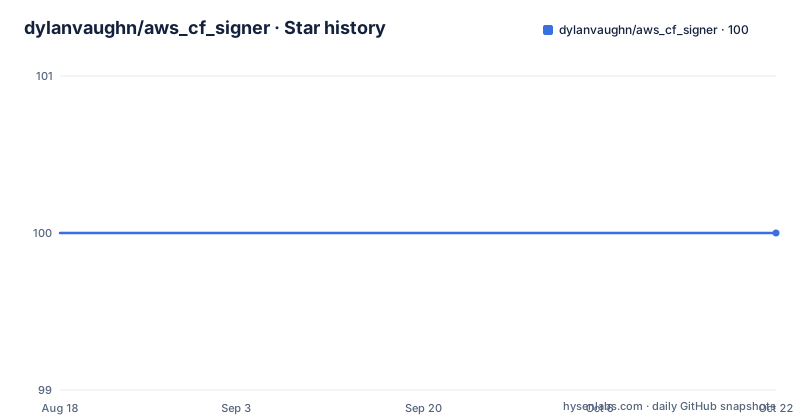
- dylanvaughn/aws_cf_signer100 ★ · +0
| Repository | 2026-08-18 | 2026-10-22 |
|---|---|---|
| dylanvaughn/aws_cf_signer | 100 | 100 |
0 Stars in the last 65 days, measured from the daily GitHub snapshot. Compare with other projects
Editorial analysis
The Problem: CloudFront Private Content Needs Signed URLs
AWS CloudFront can serve private content, but only if the requester presents a signed URL. Signing requires a private key from an AWS CloudFront key pair, a key pair ID, and an expiration time. Doing this by hand in Ruby means fiddling with RSA signing, base64 encoding, and URL escaping. aws_cf_signer exists to wrap that process into a single method call. It is aimed at Ruby developers who run a Rails or Sinatra app that needs to hand out time-limited links to files stored behind CloudFront, such as paywalled downloads or user-specific assets. The gem is deliberately small: it does not manage keys, generate policies, or talk to the AWS API. It only signs URLs.
The Signing Mechanism: RSA and Canned Policies
The README points to AWS documentation for the 'Example Canned Policy' and mentions that the signing code was adapted from a Stack Overflow answer. Based on the repository layout and the usage example, the gem loads a PEM private key, takes a key pair ID, and produces a signed URL with an expiration timestamp. The core method is `sign`, which takes a URL and an expiration date. The gem likely constructs a canned policy that includes the resource URL and the expiration time, signs it with RSA-SHA1, and appends the signature and key pair ID as query parameters. The README does not describe the exact policy format, so you must check the test file to see the expected output. The fact that the signing code came from a Stack Overflow answer suggests it is a pragmatic implementation rather than a formal AWS SDK integration. That is fine for a simple use case, but it also means the gem may not handle advanced options like custom policies or IP address restrictions.
Getting It Running: Installation and Basic Usage
Installation is standard for a Ruby gem. In a Gemfile, add `gem 'aws_cf_signer'`. Alternatively, run `gem install aws_cf_signer` on the command line. The README shows three ways to instantiate the signer. First, pass the path to the PEM file: `AwsCfSigner.new('/path/to/my/pk-1234567890.pem')`. The gem extracts the key pair ID from the filename, which is the usual AWS naming convention. Second, if your key file has a different name, pass the key pair ID explicitly as a second argument: `AwsCfSigner.new('/path/to/my/private-key.pem', '1234567890')`. Third, if the key is not on disk, pass the key content as a string, but then the key pair ID is mandatory: `AwsCfSigner.new(ENV["CLOUDFRONT_PRIVATE_KEY"], '1234567890')`. After that, you call `sign` with a URL and an expiration date. The README's example is truncated, but the test file is said to contain more examples. The key pair ID is a string, not an integer, which matches AWS's format.
Where It Falls Short: Documentation and Maintenance Gaps
The most obvious limitation is the documentation. The README is short, and the usage example is cut off mid-sentence. The only other source of examples is the test file, which is not linked or described in detail. That means you have to read the source code or the tests to understand the exact signature format and the expiration parameter's type. The README does not mention whether the expiration is a Time, a DateTime, or an integer timestamp. It also does not explain how to handle URL encoding or whether the gem works with query strings already present in the URL. Another concern is maintenance. The repository has not had a recent release listed, and the last push date is unknown. The copyright notice says 2010, which suggests the gem is old. AWS has changed its signing requirements over the years, and the gem's reliance on a Stack Overflow answer from 2010 raises the risk that it may not produce signatures that current CloudFront accepts. The test suite exists, but the README's contribution notes emphasize adding tests, so the quality of the existing tests is unclear. For a security-sensitive operation like URL signing, this lack of visibility is a real drawback.
The Right Tool? When to Choose This Over the AWS SDK
The main alternative is the official AWS SDK for Ruby, which includes CloudFront signing capabilities. The SDK is actively maintained, well documented, and supports both canned and custom policies. The difference in approach is significant: the SDK is a large dependency that brings many AWS services, while aws_cf_signer is a tiny gem with no external dependencies beyond Ruby's standard library. If you already use the AWS SDK for other purposes, adding a separate signing gem is redundant. If you only need signed URLs and want to minimize dependencies, aws_cf_signer is a lighter option. However, the SDK's signing code is more likely to be up to date with AWS's current requirements. There is also `aws-sdk-cloudfront`, which is a focused SDK module. The trade-off is between a small, opaque gem and a larger, official, and transparent one. For a production service that serves private content, the SDK's reliability may outweigh the dependency cost.
Maintenance and License: What You Need to Know
The gem is distributed under the MIT License, which is permissive and allows commercial use, modification, and redistribution. The copyright holder is listed as 'STL, Dylan Vaughn', with a copyright year of 2010. That is the only licensing information in the README. There is no contributing guide beyond the pull request notes, and the notes say not to mess with the rakefile, version, or history. That suggests the maintainer prefers a specific workflow, but it does not reveal anything about release cadence or support. The maintenance cost for you as an adopter is the need to verify the gem's behavior yourself. Since there are no recent releases, you may be relying on a gem that has not been updated in years. You should check the source code for any known issues, and consider pinning the exact version in your Gemfile to avoid surprises. The gem's age also means it may not work with newer Ruby versions, though the README does not mention any Ruby version requirements.
Editorial conclusion
Adopt aws_cf_signer if you need a tiny, dependency-light Ruby utility for signing CloudFront URLs and you are comfortable with its sparse documentation and dated codebase. Do not use it if you require active maintenance, extensive test coverage, or a guarantee of compatibility with the latest AWS SDK changes. Before adopting, verify that the signing logic matches current CloudFront requirements, especially the policy format and expiration handling, by reading the test file and comparing against AWS documentation. Also confirm the gem's behavior with your Ruby version, as the last push date is unknown and no recent releases are listed.
Frequently asked questions
Can anyone access a presigned URL?
That question belongs to AWS's documentation rather than this repository. What aws_cf_signer does is sign CloudFront URLs for private content, and the expiration date passed to the signer is required, so a signature is bounded in time rather than permanent.
Why is CloudFront blocking me from websites?
The repository does not address blocking of any kind. It is a Ruby gem for signing CloudFront URLs for private content given an AWS key_pair_id and a pem file.
How do I install aws_cf_signer?
Add gem 'aws_cf_signer' to your Gemfile, or run gem install aws_cf_signer on your system. There is no binary to download and no configuration file.
What do I pass to AwsCfSigner.new?
A path to the private CloudFront key, and optionally the key_pair_id as a second argument when the filename does not contain it. You can also pass the key material itself, for example from an environment variable, but then you must pass the key_pair_id.
How do I contribute to aws_cf_signer?
Fork it, make the change, add tests, commit without touching the rakefile, version, or history, and send a pull request. Topic branches get bonus points, and a version bump in a commit by itself is fine.
Official sources
Add this badge to your README
If you maintain this project, the badge below links readers to this analysis and shows its maintenance status from the daily GitHub snapshot. Paste the markdown into your README; add ?metric=license or ?metric=stars to the image URL for a different field.

[](https://hysenlabs.com/projects/dylanvaughn-aws-cf-signer)Star history chart for your README
[](https://hysenlabs.com/projects/dylanvaughn-aws-cf-signer)