tensorflow-nlp-tutorial, the notebook half of a 1,200-page Korean NLP book
A deep learning NLP repository using TensorFlow, covering everything from text preprocessing to downstream tasks with recent models such as Topic Models, BERT, GPT and LLMs.
At a glance
- What is it?
- Twenty-seven chapter folders covering Bag of Words through RAG and LLM fine-tuning, paired with a WikiDocs e-Book. Here is the numbering, the update history, and what the gaps in it mean.
- Who is it for?
- This repository is worth your time if you read Korean and want the code that matches a specific chapter of a specific book, because the folders map to chapters rather than to topics and the theory lives somewhere else. It is a poor fit if you need current library APIs, since most of it was written against TensorFlow 2.0 in 2022, or if you need a permissive licence, because the repository does not carry one.
- Can I use it commercially?
- Not without permission. GitHub finds no licence file in the repository, and without a licence all rights are reserved by default: you may read the code but not reuse it. Check the README, or ask the authors, before using it.
- Is it still maintained?
- Yes. The repository last received commits 163 days ago.
- What is it written in?
- Mainly Jupyter Notebook, according to GitHub's language statistics.
Answers come from the project's GitHub data, last synced on November 15, 2026, and from our analysis. They are not legal advice.
Star history
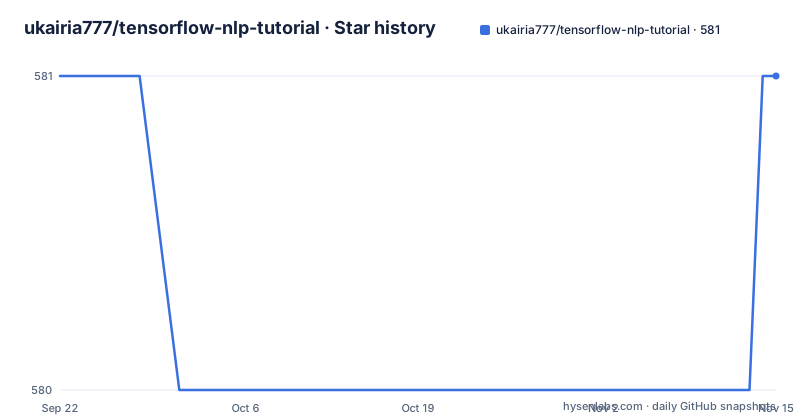
- ukairia777/tensorflow-nlp-tutorial581 ★ · +0
| Repository | 2026-09-22 | 2026-11-15 |
|---|---|---|
| ukairia777/tensorflow-nlp-tutorial | 581 | 581 |
0 Stars in the last 54 days, measured from the daily GitHub snapshot. Compare with other projects
Editorial analysis
The repository is the code half of a 1,200-page book
This is not a standalone tutorial set. It is the practice repository for a book, and the two halves are linked rather than merged. The book is Introduction to Natural Language Processing with Deep Learning, published on WikiDocs at book 2155, and the stated size is 1,200 pages. The repository holds the code that goes with it, and the division of labour is explicit: the theoretical explanation underlying the code was written and published through that e-Book, and these folders are where you run it. That structure explains a lot about the shape of what is here. Chapters arrive when the book needs them, directory names track book chapters rather than a curriculum designed for the web, and nobody optimised the repository for someone arriving without the book.
Chapters 03 and 15 are missing, and 27 and 28 say Legacy
The top level is a numbered sequence with visible damage to it. It runs from `01. Introduction` through `28. Text Summarization with Attention (Legacy)`, and two numbers in the middle are absent: there is no 03 and no 15, with the numbering jumping from 02 to 04 and from 14 to 16. The last two folders carry an explicit qualifier in their own names, Memory Network and Text Summarization with Attention, both marked Legacy. So the tree is telling you two different things in two different ways. The gaps are silent and you have to notice them, while the legacy markers are loud and were put there on purpose, which suggests the author wanted those techniques clearly labelled as history rather than quietly left behind.
The `.py` files are generated, and the Colab link lives inside them
There is a practical detail that decides how you use any chapter here. Open the `.py` file for a practice exercise and the Colab link is written inside it. Those Python files are not hand written: they are auto-converted from the corresponding `.ipynb` files, and conversion is the only transformation applied. So the notebook is the source and the script is the artifact, which means editing the script is pointless, since the next conversion overwrites it. Opening the linked page in Chrome runs the exercise with no separate Python installation, which is why the author settled on this arrangement rather than a requirements file. The primary language of the repository is accordingly recorded as Jupyter Notebook rather than Python.
One 2025 entry added chapters 21 through 25 at once
The update log is dated and short, and its shape tells you where the effort went. The repository opened on 2022-01-01. Most entries land in the first two months of 2022. Then there is a gap until 2024-02-18, when chapter 24, LLM fine-tuning, was added. The last content entry is 2025-06-27, and it covers chapters 21 through 25 together: basic RAG, advanced RAG, LLM fine-tuning, and VLM fine-tuning, described as an RAG addition together with LLM and VLM fine-tuning code. Five chapters landing in one commit is the shape of catching up rather than of incremental work, and it explains why the newest material in this repository is also its thinnest.
The 2022 burst covers BERT, KoGPT-2, KeyBERT, CTM, and BERTopic
Five entries in seven weeks did most of the building. On 2022-01-03, chapter 18 arrived with BERT for text classification, named entity recognition, question answering, natural language inference, and a chatbot built on SBERT. On 2022-01-18, chapter 19 added KoGPT-2 for text generation, chatbot work, and text classification. Two days later, chapter 26 gained KeyBERT for keyword extraction. On 2022-02-16 the same chapter gained Combined Topic Models, and on 2022-02-24 chapter 19 added CTM in Korean along with BERTopic in English and Korean. Note that chapter 20, covering BART and T5, has no dated entry at all, so the log does not tell you when it landed or in what state.
Directory names carry the task list, so you can navigate without the book
Several folder names include the tasks they cover, which is what makes the repository usable for someone who has not read the book. Chapter 18 is Fine-tuning BERT with Cls, NER, and NLI in the name. Chapter 19 is Fine-tuning GPT-2 with Cls, Chatbot, and NLI. Chapter 26 is Topic Modeling with LDA and BERT-Based. The earlier sequence is a conventional progression you can guess at from the names alone: Bag of Words and TF-IDF, Vector Similarity, Machine Learning, Multilayer Perceptron, RNN, Word Embedding, RNN Text Classification, 1D CNN Text Classification, RNN Sequence Labeling, Subword Tokenizer, and Seq2Seq for NMT. That is the fastest way to decide whether this repository covers the ground you need before you read a word of it.
TensorFlow 2.0 is a hard constraint, and a PyTorch twin exists
The framework is fixed rather than negotiable. Both the English and Korean summaries say the tutorials are built on TensorFlow 2.0 or newer, and there is no PyTorch path in this repository. The author has written a separate one, at ukairia777/pytorch-nlp-tutorial, and the README points readers there in both languages. That is a useful thing to know before you spend an afternoon, because the two repositories will not be interchangeable at the API level even where the chapter numbering lines up. The practical question for any chapter here is not whether the technique is current but whether the TensorFlow API it calls is, and for anything written in early 2022 against the 2.x line, assume it needs work before it runs on a current install.
No licence, no releases, and no page to send anyone to
Three small facts that affect what you can do with it. There is no licence file in the repository tree and no licence is declared, so the default position is that you have no permission to reuse the code, which is a different situation from a permissive licence and an unusual one for something with this many forks. There are no GitHub releases either, so the history is the only record of what changed and when. And there is no project homepage; the e-Book on WikiDocs is the nearest thing to a front door. The default branch is main and the last push was on 2026-06-05, which is later than the last dated content entry of 2025-06-27, so the recent commits are maintenance rather than new chapters.
Editorial conclusion
This repository is worth your time if you read Korean and want the code that matches a specific chapter of a specific book, because the folders map to chapters rather than to topics and the theory lives somewhere else. It is a poor fit if you need current library APIs, since most of it was written against TensorFlow 2.0 in 2022, or if you need a permissive licence, because the repository does not carry one. Before you build on any of it, check the framework version in the chapter you care about, read the two legacy folders with the expectation that they describe techniques the field has moved past, and take the theory from the book rather than the notebooks.
Frequently asked questions
Do I need the book to use tensorflow-nlp-tutorial?
The repository is the practice half of a WikiDocs book called Introduction to Natural Language Processing with Deep Learning, roughly 1,200 pages, published at book 2155. The theoretical explanation lives in the book and the code lives here, so the folders are navigable on their own but the reasoning is not.
Can I run the tensorflow-nlp-tutorial exercises without installing Python?
Yes. Each exercise has a Colab link written inside its .py file, and opening that link in Chrome runs it without a separate Python install. Note that the .py files are auto-converted from the .ipynb notebooks, so the notebook is the source and edits to the script will be overwritten.
Which chapters are marked legacy in tensorflow-nlp-tutorial?
The two last folders in the tree, Memory Network and Text Summarization with Attention. The naming also skips chapter 03 and chapter 15 entirely, so the sequence runs 01 to 02, 04 to 14, then 16 onward.
Is there a PyTorch version of tensorflow-nlp-tutorial?
Not in this repository, which is fixed to TensorFlow 2.0 or newer. The same author maintains a separate PyTorch tutorial at ukairia777/pytorch-nlp-tutorial, and the README links to it in both the English and Korean sections. The two will not be interchangeable at the API level.
Official sources
Add this badge to your README
If you maintain this project, the badge below links readers to this analysis and shows its maintenance status from the daily GitHub snapshot. Paste the markdown into your README; add ?metric=license or ?metric=stars to the image URL for a different field.

[](https://hysenlabs.com/projects/ukairia777-tensorflow-nlp-tutorial)Star history chart for your README
[](https://hysenlabs.com/projects/ukairia777-tensorflow-nlp-tutorial)Was this useful?