iA-Fonts: three writing typefaces shipped with a usage policy rather than a licence grant
Free variable writing fonts from iA
At a glance
- What is it?
- The Mono, Duo and Quattro faces behind iA Writer, modified from IBM Plex and hosted on GitHub. The README is a set of five usage rules, and the directory you would look for to settle the licensing question is not there.
- Who is it for?
- iA-Fonts is a well-kept font repository that behaves like a licence agreement, and reading it that way is the whole task. There is no build step and nothing to compile; what you do instead is decide which of the five guidelines applies to you, and the third one, use IBM Plex instead, is the answer for most editor projects.
- Can I use it commercially?
- Not without permission. GitHub finds no licence file in the repository, and without a licence all rights are reserved by default: you may read the code but not reuse it. Check the README, or ask the authors, before using it.
- Is it still maintained?
- Yes. The repository last received commits 21 days ago.
- What is it written in?
- GitHub does not report a main language for this repository.
Answers come from the project's GitHub data, last synced on October 23, 2026, and from our analysis. They are not legal advice.
Star history
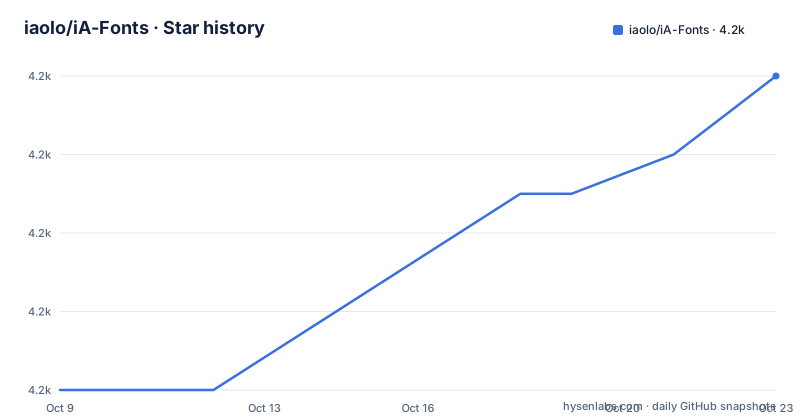
- iaolo/iA-Fonts4,184 ★ · +8
| Repository | 2026-10-09 | 2026-10-23 |
|---|---|---|
| iaolo/iA-Fonts | 4.2k | 4.2k |
8 Stars in the last 14 days, measured from the daily GitHub snapshot. Compare with other projects
Editorial analysis
A repository that is mostly a permissions document
Almost everything in this repository is the README, and the README is not a description of the software. It opens by saying the iA Writer fonts are bundled with iA Writer for Android, Windows, macOS, iPadOS and iOS, and then states that iA Writer is the only text editor with which the authors approve bundling these fonts. After that come five numbered usage guidelines, a note about crediting, three links to background articles, and a paragraph about where the fonts came from.
That is the entire document, and it is worth being clear about what kind of project this is. There is no source code, no build system, no test suite and no CLI. The tree at the root of the default branch holds four entries: `.gitignore`, `README.md`, and three directories named `iA Writer Duo`, `iA Writer Mono` and `iA Writer Quattro`. The repository page records no primary language and no licence, which for a font collection is close to normal but does put the licensing question somewhere unusual, as the next sections get to.
The described purpose is precise: free variable writing fonts. These are fonts designed for continuous prose on screen rather than for headings, and the repository exists to make the three typefaces obtainable outside the application that ships them, on the terms that follow.
Three families and no technical specification
The names distinguish the three: Mono, Duo and Quattro. The README does not define any of them, and there is no specimen sheet, no metrics table, no glyph coverage list and no statement of weights or styles anywhere in the repository. If you are trying to decide which one suits a writing tool, the repository will not get you there.
What it does instead is point at two articles. One is titled around the search for a perfect writing font and is linked as background on Duospace, and the other covers iA Writer Mono, Duo and Quattro together under a title about a typographic Christmas. Both live on ia.net. So the design rationale for the three faces is published, but it lives on the company blog rather than in the project, which is a reasonable choice for a design studio and a mildly annoying one for an engineer deciding whether to ship a font.
The directory names do carry one useful signal: each family is in its own top-level folder, which means you can take a single family without pulling the others. Whether each directory contains release-ready files, sources, or both is not something the README states, so the sensible move is to open the three folders and look before writing any packaging step around them.
One small oddity in the file itself: the document begins with the heading `iA-Fonts` and then repeats it immediately as a second, identical top-level heading. It is cosmetic, but it is the kind of detail that tells you the README was written as a standalone document and pasted in, rather than maintained as a repository landing page.
The fonts are modified IBM Plex, and the licence file is missing
The last paragraph of the README is the one that decides everything else: these fonts are modified versions of IBM Plex, the upstream project is available at github.com/IBM/type, and readers are told to read the licence file before using, modifying or distributing the fonts.
That instruction cannot be followed here. The repository tree contains no LICENSE file of any kind, and the repository page records no licence identifier, so the licence text the README points you to exists somewhere other than this repository. In practice it lives with the upstream Plex project, which is the correct place to read it, since a derived font's terms come from its ancestor.
Which raises the question a careful reader should ask: what happens to a modified font's terms. IBM Plex ships under a licence designed for exactly this, and the standard practice under those terms is that a derivative must not reuse the reserved Font Name, which is why forks like this one carry the iA name rather than the Plex name. The iA guidelines point the other way in one line, telling you not to distribute renamed versions of their fonts with only minor changes. Those two instructions are not obviously in conflict, since the Plex rule is about not passing off a derivative as the original and the iA rule is about not laundering iA's own work, but a fork under a reserved name that has been substantially redesigned sits close enough to the line that you should read both texts rather than assume.
The practical instruction, then, is not to guess: open the upstream repository, read its licence, and apply it to the modified files in the three directories here. Note that guideline 5 and the credit requirement mean a commercial product wanting the same typographic feel has a documented path forward that does not involve these files at all.
Five guidelines, and the third one tells you what to use instead
The guidelines are the substance of the README, so they are worth taking one at a time rather than as a block.
The first says not to create text editors that bundle the fonts or use them as default typefaces, and it explicitly extends this to minimalist text editors. The second says not to distribute renamed versions with only minor changes, which rules out the rename-to-avoid-attribution trick. The third points anyone wanting a similar typeface for their own editor to IBM Plex. The fourth permits installing the fonts as custom fonts for personal use in other text editors, while forbidding redistribution of them alongside those editors. The fifth says not to distribute plugins, themes or other products that imitate iA Writer, whether paid or free.
Read together, these draw a line around a specific asset rather than around the editor category. Personal use is allowed and uncontroversial. Bundling in an editor is not, with no exception for open source and no exception for free software, which the fifth clause makes explicit by covering paid and free products alike. Redistribution is the greyest area: rule four allows installation for personal use in another editor but forbids shipping them with it, so the test is whether the font travels with your product or sits in one user's font directory.
Guideline three is the most useful line in the document for anyone building something. The studio has told you what to use instead, and named the project. That converts a licensing question into a design substitution, which is much easier to resolve than a permission request that may never be answered.
The anti-imitator clause reaches beyond fonts
Guideline five is the one that surprises people, and it says more about the studio's position than the other four combined. It does not restrict the fonts. It restricts distributing plugins, themes or other products that imitate iA Writer.
The scope is broad on purpose: plugins and themes are the layers that make an editor feel like iA Writer without shipping any of its code or fonts. A minimalist text editor with an iA-like interface, an iA-like syntax theme and a matching default face would gather all three at once. The guideline says do not ship that combination, and it says do not ship it whether the product is sold or free.
The README also asks that forks and uses outside text editors clearly credit iA Writer, and it recommends an article on copycats for what it calls the philosophy of creativity and copying. That recommendation is the tell: the studio treats copying as a design question rather than purely a legal one, and this repository is where that position is stated in concrete, enforceable terms.
For a reader, the practical consequence is that these three directories are the most protected artefacts associated with iA Writer, more so than the application itself. Downloading iA Writer gets you the fonts legitimately, bundled by the only party with approval. Everything else in this repository is for inspection, personal installation and credited reuse outside text editors.
An active repository with no releases and no version trail
The repository is not archived and the last push was on 2026-10-02, which means the files are being kept current. There are no GitHub releases, so there is no tag to pin, no changelog and no stated version for any of the three families. If you depend on these files in a build, pin to a commit hash rather than to a release that does not exist.
There is also no topic list, no homepage field beyond the iA site, and no code to review. The iA Writer product page is the natural place to find out which family a given platform version ships, and that is the thing to check first if you are trying to match the look of the app rather than just obtain the files.
None of that is criticism. A font repository that is three folders and a page of rules is doing exactly one job, and the fact that the README is short is a feature when what you need is a yes or a no rather than an explanation. The one genuine gap in the setup is the missing licence file, and since the README explicitly tells you to read one before using the fonts, that gap sits directly in the path of anyone doing this properly.
Editorial conclusion
iA-Fonts is a well-kept font repository that behaves like a licence agreement, and reading it that way is the whole task. There is no build step and nothing to compile; what you do instead is decide which of the five guidelines applies to you, and the third one, use IBM Plex instead, is the answer for most editor projects. Install them as custom fonts for your own writing if that is all you need, credit iA Writer if you fork or use them elsewhere, and do not redistribute them inside another product. Before you commit to anything commercial, go to the upstream IBM Plex project and read the licence there, because the repository you are reading points you to a licence file that the tree does not contain.
Frequently asked questions
What font does iA Writer use?
Three of them: iA Writer Mono, iA Writer Duo and iA Writer Quattro, each in its own directory in this repository. They are bundled with iA Writer for Android, Windows, macOS, iPadOS and iOS, and the README describes them as free variable writing fonts.
Can I bundle the iA Writer fonts in my own text editor?
No. The first usage guideline says not to create text editors that bundle the fonts or use them as default typefaces, and it names minimalist text editors specifically. Guideline three points you to IBM Plex if you want a similar typeface for your own editor.
Can I install the iA Writer fonts in another editor for my own use?
Yes, as custom fonts for personal use. The fourth guideline permits that and forbids redistributing them alongside those editors. If you fork the fonts or use them outside a text editor, the README asks that iA Writer be clearly credited.
Under what licence are the iA-Fonts released?
The repository records no licence identifier and contains no licence file, even though the README tells you to read one before using the fonts. The fonts are modified versions of IBM Plex, so the terms come from the upstream project at github.com/IBM/type, and that is where to read them.
Official sources
Add this badge to your README
If you maintain this project, the badge below links readers to this analysis and shows its maintenance status from the daily GitHub snapshot. Paste the markdown into your README; add ?metric=license or ?metric=stars to the image URL for a different field.

[](https://hysenlabs.com/projects/iaolo-ia-fonts)Star history chart for your README
[](https://hysenlabs.com/projects/iaolo-ia-fonts)Was this useful?