jceb/vim-orgmode: Org mode outlining and TODO management inside Vim
Text outlining and task management for Vim based on Emacs' Org-Mode
At a glance
- What is it?
- jceb/vim-orgmode brings Org mode style folding, TODO states, tags and hyperlinks to Vim. It is a partial reimplementation, not a full Org mode, and the README points to doc/orgguide.txt for both installation and usage.
- Who is it for?
- Adopt jceb/vim-orgmode if you already live in Vim and want heading folding, TODO states, tags and hyperlinks without switching editors; the README states the plugin is usable but does not support all Org mode features. Skip it if you need a complete Org mode, since export goes through Emacs rather than being native.
- Can I use it commercially?
- Check first. The repository uses a licence we do not classify automatically, so read its LICENSE file before any commercial use.
- Is it still maintained?
- Activity is slowing. The repository last received commits 8 months ago.
- What is it written in?
- Mainly Python, according to GitHub's language statistics.
Answers come from the project's GitHub data, last synced on November 24, 2026, and from our analysis. They are not legal advice.
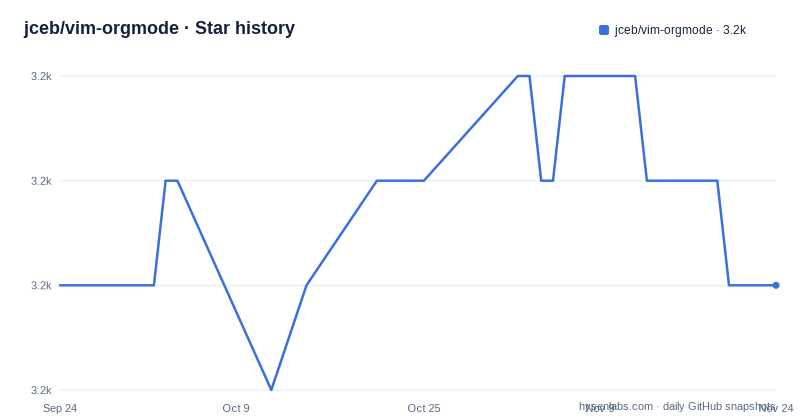
Star history
- jceb/vim-orgmode3,185 ★ · +0
| Repository | 2026-09-24 | 2026-11-24 |
|---|---|---|
| jceb/vim-orgmode | 3.2k | 3.2k |
0 Stars in the last 61 days, measured from the daily GitHub snapshot. Compare with other projects
Editorial analysis
What jceb/vim-orgmode actually solves for Vim users
Org mode's reputation rests on a small set of behaviours: headings that fold, TODO keywords that move a task through states, tags attached to headings, and links that jump to files or webpages. Emacs users get these from one package. Vim users historically did not, and jceb/vim-orgmode exists to close part of that gap. The README is explicit about the ambition: the project was born after the author listened to a Floss Weekly episode introducing Emacs Org mode, and it "aims at providing the same functionality for Vim." The audience is therefore narrow and specific: people who have already invested in Vim's modal editing, its plugin layout and its file handling, and who want structured notes and task lists in that environment rather than opening Emacs alongside it. The README does not pitch the plugin at teams, at shared task trackers, or at anyone who wants a web interface. It is a personal outlining tool for an editor you already use.
How the plugin is put together: Vim runtime files plus Python
The repository layout tells you more about the mechanism than the README does. The top level contains ftdetect/, ftplugin/, indent/ and syntax/ directories, which is the standard shape of a Vim filetype plugin: ftdetect/ decides that a file is Org, ftplugin/ holds buffer-local mappings and commands, indent/ supplies indentation rules, and syntax/ drives highlighting. The Makefile installs exactly those five directories (doc, indent, ftdetect, ftplugin, syntax) into $(PREFIX)/share/vim, copying .txt, .cnf, .py and .vim files with mode 0644. Python is the primary language of the repository, and the Makefile's check target runs tests/run_tests.py under python2, so a part of the logic lives in Python files that ship inside the same runtime directories rather than in a separate package. Folding and navigation are Vim-side behaviour; the Python layer handles the parts that are awkward to express in Vimscript. There is no daemon, no server, no index file. Everything operates on the buffer you have open.
Installing jceb/vim-orgmode and folding your first Org file
The README states plainly that installation and usage instructions are found in doc/orgguide.txt. That is the authoritative source, and it is the file to read before running anything. What the repository does show is a Makefile with an install target that copies the runtime directories into $(VIMDIR), which defaults to /usr/local/share/vim. The PREFIX variable can be overridden, and DESTDIR is honoured, so a staged install into a package tree is possible. The Makefile's install recipe is:
install: doc indent ftdetect ftplugin syntax
	for i in doc indent ftdetect ftplugin syntax; do \
		find $$i -type f -name \*.txt -o -type f -name \*.cnf -o -type f -name \*.py -o -type f -name \*.vim | while read f; do \
			install -m 0755 -d $(DESTDIR)$(VIMDIR)/$$(dirname "$$f"); \
			install -m 0644 $$f $(DESTDIR)$(VIMDIR)/$$f; \
		done; \
	done
That places doc, indent, ftdetect, ftplugin and syntax under $(VIMDIR), which defaults to /usr/local/share/vim, and DESTDIR lets you write into a staged root first. The Makefile also defines vmb and vba targets that build a Vimball package, and vmb.gz and vba.gz to gzip it, which is the distribution path that matches the plugin's vim.org script page.
Once the files are on your runtimepath, open a file ending in .org. The ftdetect directory is what makes Vim pick the orgmode filetype, and the syntax directory is what colours headings, TODO keywords and tags. The README lists the supported operations: cycle visibility of headings, navigate between headings, add, move, promote and demote headings, follow hyperlinks to files and webpages, manage TODO lists and tags, handle alphanumeric and bullet lists with checkboxes, and do basic date handling. The exact key mappings are not in the README; doc/orgguide.txt is where they are documented.
Where vim-orgmode stops short of Org mode
The README's own wording is the most useful limitation: "Currently vim-orgmode does not support all orgmode features but is quite usable." That sentence is doing a lot of work. Export is the clearest boundary. The feature list says "Export to other formats (via Emacs' Org-Mode)", which means the export path depends on Emacs being present. If you do not have Emacs installed, that feature is not available to you, and the plugin is not a self-contained replacement for Org mode's publishing pipeline. The supported list is also deliberately modest: syntax highlighting, folding, heading navigation and restructuring, hyperlinks, TODO management, tags, lists and checkboxes, and basic date handling. Anything Org mode does beyond that list is not claimed. There is a second practical constraint in the Makefile: the test target runs tests/run_tests.py with python2. The repository has a .travis.yml and a codecov badge, so continuous integration exists, but the test entry point as written assumes a Python 2 interpreter is available. Anyone planning to modify the Python side should confirm that assumption against their environment before treating make test as a working gate. Finally, the README does not document rollback, migration between versions, or what happens to an .org file edited by both vim-orgmode and Emacs; the CHANGELOG.org file is where changes are recorded.
Vimwiki and Emacs Org mode as the two real alternatives
The comparison that matters is not against another Vim plugin with identical goals, because the alternatives differ in kind. Emacs Org mode is the reference implementation this project is modelled on. Choosing it means you get the full feature set, including native export, at the cost of adopting Emacs and its configuration model. Choosing vim-orgmode means you keep Vim and accept a subset, with export routed back through Emacs anyway. Vimwiki is the other natural point of comparison, and it appears in the related searches around this project. Vimwiki is a personal wiki for Vim: it links between pages, maintains a diary, and can export to HTML. Its organising unit is the page, not the heading, and it does not centre on TODO state transitions or Org style tag inheritance. If your notes are a linked web of pages, Vimwiki's model fits better. If your notes are a single deeply nested outline where tasks live on headings and move through states, vim-orgmode's model fits better. Neither is a drop-in for the other, and the file formats are not interchangeable.
Maintenance, licence and what it costs to keep running
The repository is not archived. The last push was on 2026-03-09, which is within six months of today, so the codebase has seen recent activity. That is the only maintenance signal available here: the repository has no published releases, so there is no version history to reason about, and the CHANGELOG.org file is where the project records changes. Practically, the upgrade cost is low because the plugin is a set of Vim runtime files plus Python modules installed into a Vim directory. Upgrading means replacing those files, and the Makefile's install target does exactly that by overwriting with mode 0644. The risk is not upgrade complexity but drift: an .org file that vim-orgmode has restructured may not round-trip cleanly through Emacs, and the README does not promise that it will. On licensing, the repository contains a LICENSE file and the README says only that "Information about the license is found in file LICENSE." The GitHub metadata reports the licence as NOASSERTION, meaning no standard licence identifier was detected. Read the LICENSE file yourself before redistributing or bundling the plugin; the README gives no further detail, and this is not a substitute for legal advice. Note also that the Makefile's install target copies files with mode 0644 while creating directories with 0755, so a system-wide install writes into a shared Vim tree and will be overwritten by the next such install.
Editorial conclusion
Adopt jceb/vim-orgmode if you already live in Vim and want heading folding, TODO states, tags and hyperlinks without switching editors; the README states the plugin is usable but does not support all Org mode features. Skip it if you need a complete Org mode, since export goes through Emacs rather than being native. Before committing, read doc/orgguide.txt for the actual install and usage steps, check the LICENSE file for terms, and run make test, which the Makefile defines as cd tests && python2 run_tests.py.
Frequently asked questions
How can I use Org mode in Vim with jceb/vim-orgmode?
Install the plugin's runtime directories into your Vim tree, then open a file with the .org extension so that ftdetect assigns the orgmode filetype. The README lists the supported operations, and doc/orgguide.txt holds the installation and usage instructions.
How does jceb/vim-orgmode compare with Emacs Org mode?
The README states that vim-orgmode aims at providing the same functionality for Vim but does not support all orgmode features. Export to other formats is listed as going through Emacs' Org-Mode rather than being handled natively.
What is an alternative to vim-orgmode for note taking in Vim?
Vimwiki is the closest alternative in the Vim ecosystem. It organises notes as linked pages and a diary, whereas vim-orgmode centres on heading folding, TODO states and tags within a single outline.
Official sources
Add this badge to your README
If you maintain this project, the badge below links readers to this analysis and shows its maintenance status from the daily GitHub snapshot. Paste the markdown into your README; add ?metric=license or ?metric=stars to the image URL for a different field.

[](https://hysenlabs.com/projects/jceb-vim-orgmode)Star history chart for your README
[](https://hysenlabs.com/projects/jceb-vim-orgmode)Was this useful?