SparkEngine: A C++23 FPS Engine That Grew Into a Genre-Spanning Toolkit
A free, open-source C++23 3D game engine for FPS and beyond — DirectX 12, Vulkan, Jolt Physics, ECS, ImGui editor, AngelScript scripting
At a glance
- What is it?
- SparkEngine is a free, open-source C++23 3D game engine with a broad feature set, but its experimental backends and unverified license make adoption a careful decision.
- Who is it for?
- SparkEngine suits indie developers and small studios who want a free, source-available engine with a rich feature set and are comfortable building from source and navigating experimental backends. It is not for teams needing production-grade stability across multiple platforms or a clearly defined license; the NOASSERTION license means you must clarify legal terms before commercial use.
- Can I use it commercially?
- Check first. The repository uses a licence we do not classify automatically, so read its LICENSE file before any commercial use.
- Is it still maintained?
- Yes. The repository last received commits 4 days ago.
- What is it written in?
- Mainly C++, according to GitHub's language statistics.
Answers come from the project's GitHub data, last synced on October 22, 2026, and from our analysis. They are not legal advice.
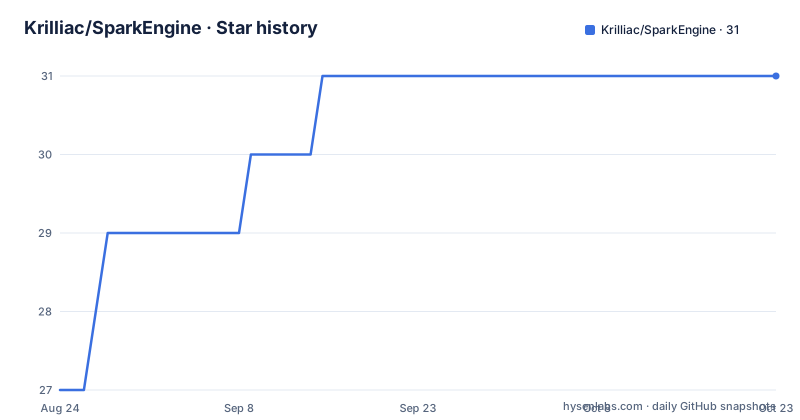
Star history
- Krilliac/SparkEngine31 ★ · +4
| Repository | 2026-08-24 | 2026-10-22 |
|---|---|---|
| Krilliac/SparkEngine | 27 | 31 |
4 Stars in the last 59 days, measured from the daily GitHub snapshot. Compare with other projects
Editorial analysis
What SparkEngine Actually Solves
SparkEngine targets developers who want a modern C++ game engine without the cost or lock-in of commercial products. It began as an FPS-focused engine, but the README now lists genre templates for RPG, MMO, RTS, racing, open-world, and platformers. The core problem it addresses is the gap between low-level rendering APIs and high-level game logic. It provides a render hardware interface (RHI) that abstracts DirectX 11, DirectX 12, Vulkan, OpenGL, Metal, and a null backend, so you can write rendering code once. It also bundles an Entity Component System (ECS) based on EnTT, Jolt Physics, AngelScript scripting, and an ImGui-based editor. The intended audience is C++ programmers who want control over the engine internals, not designers looking for a no-code tool. The editor has 65 dockable panels, which suggests a serious attempt at a full workflow, but the engine's complexity means it is not for beginners.
Architecture: RHI, ECS, and the Editor
The engine's architecture is visible in its three pillars: a render hardware interface, an entity component system, and a toolchain. The RHI is the foundation, with six backends. DirectX 11 is marked stable and primary on Windows, while DirectX 12, Vulkan, OpenGL, and Metal are experimental. NullRHI is stable and allows headless or software rendering via llvmpipe, which is useful for CI testing. The ECS uses EnTT, a well-known header-only library, and the engine ships over 75 component types, covering FPS weapons, vehicles, inventory, quests, and dialogue trees. The editor, SparkEditor, is built with ImGui and provides 65 dockable panels. The README lists panels for scene construction, asset workflows, shader editing, profiling, multiplayer operations, collaboration, dedicated servers, world streaming, and live region design. The editor is not a separate tool; it is part of the engine runtime, which means you can edit and run in the same process. This tight integration is a double-edged sword: it speeds iteration but couples the editor to the engine's stability.
Getting It Running: Build Commands and Templates
The README provides concrete build steps. On Windows, you clone with submodules, then run `generate.bat -g "Visual Studio 17 2022" release` and `build.ps1 -config Release -editor -angelscript`. On Linux or macOS, you use `./generate.sh release -g Ninja` and `./build.sh release`. The build produces binaries under `build/bin/<Config>`, for example `build/bin/Release/SparkEditor.exe`. Requirements are MSVC 19.36+, GCC 13+, Clang 17+, and CMake 3.25+. To create a game module, you install the engine with `cmake --install build --prefix ~/SparkEngine-install`, copy a template like `Templates/EmptyProject`, then configure with `cmake -B build -DCMAKE_PREFIX_PATH=~/SparkEngine-install` and build. You run the game with `./SparkEngine -game ./libMyGame.so`. The README mentions a bootstrap installer that clones and builds a selected engine revision, and rolling Windows packages are published from CI-certified commits. This suggests a functional distribution pipeline, but the reliance on nightly builds means you are always on a moving target.
Feature Breadth: Rendering, Physics, Scripting, and Networking
The feature list is extensive. Rendering includes PBR materials, global illumination via DDGI and adaptive probe volumes, forward/deferred/clustered paths, cascaded shadow maps, GPU-driven rendering, virtual texturing, mesh shaders, DXR 1.1, FSR upscaling, and a 35-node shader graph. Post-processing covers bloom, HDR tone mapping, TAA, FXAA, MSAA, depth of field, motion blur, volumetric fog, lens flares, and light shafts. Physics uses Jolt Physics with rigid bodies, 15 collision shapes, 12 constraint types, vehicles, ragdolls, cloth, soft bodies, and destruction. It supports deterministic mode for replays and multiplayer. Scripting is multi-language: AngelScript with hot-reload and state preservation, visual scripting that compiles to AngelScript, a shader graph, and Lua bindings. Networking is UDP-based with entity replication, client-side prediction, server reconciliation, and lag compensation. It also claims MMO-scale architecture with AreaServer and WorldServer, entity migration, and load balancing. This breadth is impressive on paper, but the README does not describe the maturity of each feature. Experimental backends like Vulkan and Metal may have gaps.
Limitations and Failure Modes
The most obvious limitation is backend stability. DirectX 11 is the only stable Windows backend; DirectX 12, Vulkan, OpenGL, and Metal are all experimental. If you target Linux or macOS, you are relying on experimental code. The README says Vulkan 1.4 is experimental on Linux and Windows, and Metal is in progress on macOS. That means cross-platform production use is risky. Another limitation is the license. The repository license is marked as NOASSERTION, which is not a standard open-source license. The README says "free, open-source," but NOASSERTION means the license is not recognized by common license identifiers. You cannot assume you have redistribution rights. The build process is also heavy: it requires a recent compiler, CMake, and submodules. The README mentions troubleshooting but does not detail common issues. Finally, the engine's feature list is so large that it is hard to verify quality. For example, the AI budget limiter supports 100+ agents, but there is no benchmark data. You must test these features yourself.
Alternatives and How They Differ
The main alternative is Godot, a mature open-source engine with a stable license (MIT) and a built-in editor. Godot uses its own scene system and GDScript, not C++ as the primary language. You can write C++ modules, but the workflow is different. SparkEngine is C++-first, which appeals to programmers who want direct control over memory and performance. Another alternative is O3DE, which is also C++ and open-source, but it has a steeper learning curve and a different ECS model. O3DE uses a component model that is more formalized. SparkEngine's advantage is its breadth of built-in systems, like the FPS weapon editor and the MMO server architecture, which you would have to build yourself in Godot. However, Godot has a larger community and more documentation. The choice depends on whether you value C++ control over ecosystem maturity.
Maintenance and Upgrade Costs
The project is actively maintained, with the last push in August 2026 and a nightly release. The README emphasizes CI-certified builds, which is a good sign. However, the use of nightly builds means you must track changes. The build system uses CMake and submodules, so updates are straightforward but may break if dependencies change. The editor and engine are compiled together, so any engine change requires a rebuild. The AngelScript hot-reload feature reduces iteration time, but it only applies to scripts, not engine code. The license uncertainty is a maintenance risk: if the license changes or is clarified, you may need to re-evaluate your project. There is no mention of a long-term support policy. The project has a Discord server, but no public roadmap. You should expect to maintain your own fork if you need stability.
Editorial conclusion
SparkEngine suits indie developers and small studios who want a free, source-available engine with a rich feature set and are comfortable building from source and navigating experimental backends. It is not for teams needing production-grade stability across multiple platforms or a clearly defined license; the NOASSERTION license means you must clarify legal terms before commercial use. Verify the license status, test the experimental Vulkan and Metal backends on your target hardware, and review the CI-certified nightly build before committing a project.
Frequently asked questions
what is spark engine, the one with six graphics backends?
This repository is unrelated to the Apache data processing framework. Spark Engine is a C++23 3D game engine with a shared resource hardware interface over six graphics backends, Jolt Physics, an EnTT based entity component system, AngelScript scripting and an ImGui based editor, first built for first person shooters and now shipping templates for other genres.
What are the disadvantages of Spark as the engine project documents them?
The readme states several itself. Only DirectX 11 and a null renderer sit inside the stable one profile, and both are annotated blocked and uncertified. Hybrid ray tracing is unreachable on the Windows Direct3D 11 path, the default forward pipeline has no shadow term, the experimental upscaling pass is not executed in the frame path, and no versioned shipping configuration artifact has same-commit qualification across the install, upgrade, rollback and release gates.
How does Spark actually work when building the engine?
You clone recursively for submodules, then configure and build. Windows uses CMake presets as the primary path, with a batch file and PowerShell script still supported; Linux and macOS use a generate script taking a configuration and a generator, then a build script. Compilers must meet stated minimums and CMake must be at least 3.25.
spark engine vs sql engine, and where do I download Spark Engine?
Rolling Windows artifacts may be published for development evaluation, and they are stated not to be a versioned release and not to certify the stable profile. The readme states that the word release in an asset name denotes the build configuration only, that debug builds add runtime diagnostics, and that the bootstrap installer clones and builds the selected engine revision locally.
Official sources
Add this badge to your README
If you maintain this project, the badge below links readers to this analysis and shows its maintenance status from the daily GitHub snapshot. Paste the markdown into your README; add ?metric=license or ?metric=stars to the image URL for a different field.

[](https://hysenlabs.com/projects/krilliac-sparkengine)Star history chart for your README
[](https://hysenlabs.com/projects/krilliac-sparkengine)