all-dpi-bypass-travel: the block-bypass repository whose only dependency is a plane ticket
Универсальное решение для обхода любых сетевых ограничений: DPI-фильтров, белых списков операторов и региональных блокировок
At a glance
- What is it?
- all-dpi-bypass-travel is a README-only satirical repository. Its answer to every category of network blocking in Russia is emigration: the requirements are a foreign passport, a ticket and some money, the known issues concede it does not work without physically moving, and it ships no code at all.
- Who is it for?
- all-dpi-bypass-travel fits readers collecting documentation of a particular frustration and anyone who appreciates a fully committed parody of a technical README; there is nothing to install, adopt or evaluate beyond that. It does not fit anyone looking for an actual bypass method, since the repository contains no code and its own known-issues section states the method does not work without physically moving.
- Can I use it commercially?
- Not without permission. GitHub finds no licence file in the repository, and without a licence all rights are reserved by default: you may read the code but not reuse it. Check the README, or ask the authors, before using it.
- Is it still maintained?
- Yes. The repository last received commits 109 days ago.
- What is it written in?
- GitHub does not report a main language for this repository.
Answers come from the project's GitHub data, last synced on October 23, 2026, and from our analysis. They are not legal advice.
Star history
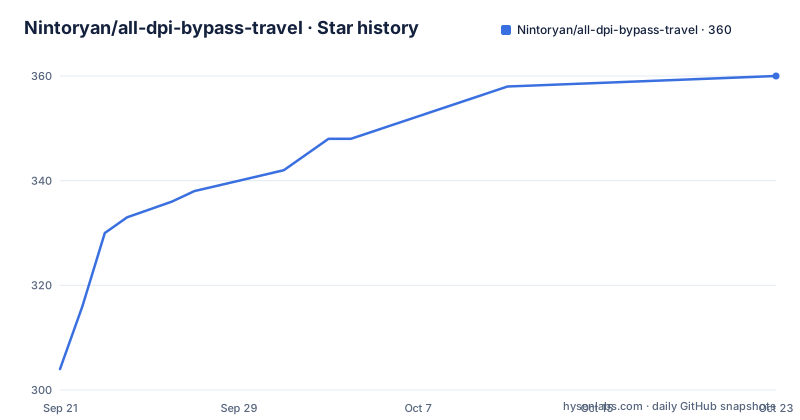
- Nintoryan/all-dpi-bypass-travel360 ★ · +56
| Repository | 2026-09-21 | 2026-10-23 |
|---|---|---|
| Nintoryan/all-dpi-bypass-travel | 304 | 360 |
56 Stars in the last 32 days, measured from the daily GitHub snapshot. Compare with other projects
Editorial analysis
A repository that is one file and no code
The repository contains exactly one file, its README, and no code, no licence and no releases. What it has is a premise, delivered in the structure of a technical project. The name promises a universal bypass for network restrictions; the content delivers a joke with a spec sheet.
The badges set the tone before any prose does. Where a real project would signal test coverage and dependency counts, these read: coverage one hundred percent, dependencies a visa and a ticket, status departed. The joke is fully committed to its format, and that commitment is what makes the repository worth reading rather than scrolling past: it is a competent parody of project documentation applied to a completely different category of solution.
The question the README poses is how to get rid of every problem with blocking in Russia, and the answer, delivered in one coarse word, is to leave. Everything after that is elaboration.
One more framing detail hides in the repository name itself: the word travel sits where a protocol name would normally sit, so the project reads as a bypass family member, a sibling of the DPI-avoidance tools people search for, whose chosen transport is an aircraft. The title alone does most of the joke's setup work before the first heading appears.
The spec sheet for emigration, played straight
The requirements section lists three items: a foreign passport, a ticket, and a small amount of money. The known issues are the honest ones: it does not work without relocating, and it requires physical presence. An exit node section, borrowing VPN vocabulary for a border crossing, points to a flight-deals site for cheap tickets.
The features list is where the parody is densest, because it enumerates the actual taxonomy of restrictions people try to defeat, IP blocks, DPI, the TSPU infrastructure, throttling, the prohibited-sites registry, and claims to bypass all of them. It requires no VPN, proxy, Tor, Shadowsocks or VLESS, only the plane ticket. It is compatible with any operating system, but requires a body upgrade. Connection speed is limited only by the physics of light in fibre. Supported protocols include HTTPS, HTTP, FTP, SIP, WhatsApp calls and even Clubhouse.
Every line is technically coherent nonsense: the terms are real, the claims are formatted like release notes, and the mechanism is a person on an aeroplane. The comedy works because the format is respected, right down to the protocol list.
The FAQ as accidental product honesty
The FAQ section is the funniest part and, read differently, the most honest documentation in the genre. Does it work without relocating? No, this is not magic; the physical layer of the network stack is serious business, and for remote work use classic proxies, which are sometimes alive, or wait for quantum teleportation in version 2.0.
How long does installation take? From several weeks to half a year, depending on the qualification of the consul and the load on the migration servers. How do you verify the bypass status? Ping a site, and if it is blocked, check your geolocation, because you may not have left the coverage zone of the regulator.
Even the compatibility question gets the deadpan treatment: yes, it works with a grandmother's router, but you will have to bring the router, and the grandmother. As product documentation, this is a masterclass in expectation-setting; every limitation is stated plainly, and none of the claims are oversold beyond the premise itself.
The restriction map it names in passing
Strip the jokes out and the features list is a recognizable inventory of the Russian restriction environment, which is why the parody lands with the audience it was written for. IP-level blocks, deep packet inspection, the TSPU carrier infrastructure, deliberate throttling, and the prohibited-sites registry are each named, and each is a real category with real tooling arrayed against it elsewhere on the platform.
The joke's central claim, that all of these yield at once to a change of jurisdiction, is also its sharpest edge: every technical countermeasure in that list is partial, arms-race-bound, or fragile in a way a border is not. The FAQ's aside that classic proxies are sometimes alive compresses the entire cat-and-mouse state of consumer circumvention into three words, and the promise of quantum teleportation in version 2.0 is the only upgrade path the README offers to the one limitation it cannot joke away, physics.
Read that way, the repository is less a prank and more a position statement in fancy dress: the reliable bypass is the one whose dependencies are a passport.
Who adopts a joke, and what it is actually for
On the merits, nobody adopts this repository. There is nothing to install, no licence to comply with, and no code to audit; the installation time is a visa queue. Reviewed as software, it is a single markdown file with a push date of 2026-07-06 and nothing else.
Reviewed as an artefact, it has a real function. It is a bookmark for a shared frustration, a compressed argument that the reliable fix for a whole class of network restrictions is jurisdictional rather than technical, and a piece of gallows humour whose README format makes the argument sharper than an essay would. The repository's own framing concedes the practical counterpoint: for people who need access without relocating, the classic tools, VPNs, proxies, Tor, Shadowsocks, VLESS, are the actual options, and the FAQ's advice to use them, with the aside that they are sometimes alive, is an accurate summary of their state.
That is the honest review position: as a tool, zero stars; as commentary, it does what it sets out to do, and its completeness as a parody is the craft on display.
Editorial conclusion
all-dpi-bypass-travel fits readers collecting documentation of a particular frustration and anyone who appreciates a fully committed parody of a technical README; there is nothing to install, adopt or evaluate beyond that. It does not fit anyone looking for an actual bypass method, since the repository contains no code and its own known-issues section states the method does not work without physically moving. Verify first: nothing, which is the point; the only check the README offers is a ping command and a geolocation lookup. It has no licence file, so the single README is covered by default copyright, and the last push was on 2026-07-06.
Frequently asked questions
Is all-dpi-bypass-travel a real bypass tool?
No. The repository consists of a single README and contains no code, no licence and no releases. It is a satirical project whose proposed solution to network blocking is emigration.
What does the README actually recommend?
Leaving the country. The requirements are a foreign passport, a ticket and some money, the known issues state it does not work without relocating and requires physical presence, and a section points to a flight-deals site for tickets.
Does it offer any technical method at all?
None. It explicitly requires no VPN, proxy, Tor, Shadowsocks or VLESS, only a plane ticket, and its FAQ suggests classic proxies for remote work, noting they are sometimes alive.
Official sources
Add this badge to your README
If you maintain this project, the badge below links readers to this analysis and shows its maintenance status from the daily GitHub snapshot. Paste the markdown into your README; add ?metric=license or ?metric=stars to the image URL for a different field.

[](https://hysenlabs.com/projects/nintoryan-all-dpi-bypass-travel)Star history chart for your README
[](https://hysenlabs.com/projects/nintoryan-all-dpi-bypass-travel)Was this useful?